
Bridging Two Worlds
Comparing Classical Political Thought and Statecraft in India and China
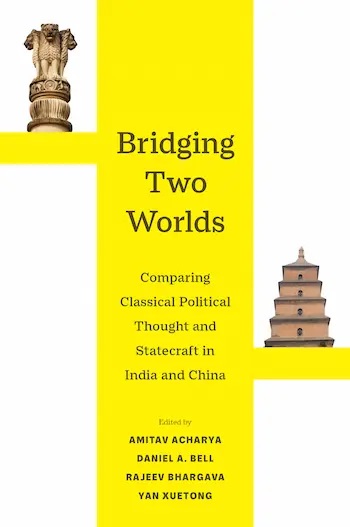
The rise of China and India could be the most important political development of the twenty-first century.
What will the foreign policies of China and India look like in the future? What should they look like? And what can each country learn from the other? Bridging Two Worlds gathers a coterie of experts in the field, analyzing profound political thinkers from these ancient regions whose theories of interstate relations set the terms for the debates today. This volume is the first work of its kind and is essential reading for anyone interested in the growth of China and India and what it means for the rest of the world.
Content
- Setting the Stage, Part I: Overview of the Project, Daniel A. Bell
- Setting the Stage, Part II: Why Compare the Classical Political Thought of China and India?, Amitav Acharya
- Mining the Past to Construct the Present: Some Methodological Considerations from India, Patrick Olivelle
- Some Methodological Reflections: In Defense of Philosophy of Culture and Thick Generalizations, Roger T. Ames
- How Do Xunzi and Kautilya Ponder Interstate Politics?, Yan Xuetong
- Ashoka’s Dhamma as a Project of Expansive Moral Hegemony, Rajeev Bhargava
- A Comparative Study on the International Political Thoughts of Han Feizi and Kautilya (Chanakya), Xu Jin
- The Spectre of “Amoral Realism” in International Relations: A Classical Indian Overview, Deepshikha Shahi
- The Particularity of Ancient China as an Empire, Zhou Fangyin
- Ideas of Empire in Ancient India in a Comparative Frame, Upinder Singh
- The Mahābhārata, Mencius, and the Modern World: Reflections on Dharmayuddha and Ānṛśaṁsya, Kanad Sinha
- Mencius on Just War: A Comparison with Political Thought in Ancient India, Daniel A. Bell
- India’s Diplomacy in Absentia: Violence, Defense, Offense, Deep K. Datta-Ray
- From Ancient Silk Road to Modern Belt and Road Initiative: A Signaling Approach to Trust-Building across Narratives, Zhao Yujia
- Balancing in Ancient China, Qi Haixia
- International Order in Ancient India, Manjeet S. Pardesi
Reviews
“This brilliant volume shines a light on the two great civilizations that will once again drive world history. No volume could be more timely, more relevant, and more needed than this one.” — KISHORE MAHBUBANI, Distinguished Fellow, Asia Research Institute, NUS, and author of The Asian 21st Century
“With the recently elevated economic and political power of China and the great potential of India in the twenty-first century, interdisciplinary dialogue and engagement such as is found in this book is necessary for contemporary debates in political theory and international relations.” — KUIYI SHEN, Professor of Asian Art History, Theory, and Criticism, University of California, San Diego
Author information
AMITAV ACHARYA is Distinguished Professor of International Relations and UNESCO Chair in Transnational Challenges and Governance at the School of International Service, American University (Washington, DC).
RAJEEV BHARGAVA is Honorary Fellow at the Centre for the Study of Developing Societies (Delhi) and Director of its Parekh Institute of Indian Thought.
YAN XUETONG is Distinguished Professor of International Relations at Tsinghua University (Beijing) and Foreign Member of the Russian Academy of Sciences.